



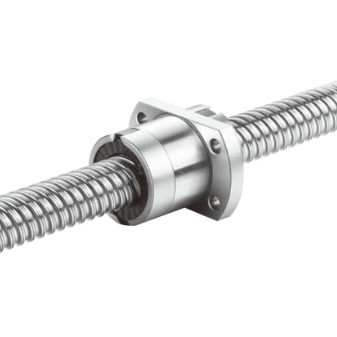
For machinery builders and industrial buyers, selecting a dependable Ball Screw Manufacturer can influence the accuracy and stability of an entire motion system, while an experienced Ball Screw Manufacturer can provide suitable designs, controlled production, and technical support for different equipment requirements. Ball screws are widely used in CNC machines, automation equipment, robotics, inspection systems, and other applications where rotary power needs to be converted into controlled linear movement.
How Ball Screws Support Modern Machinery
A ball screw consists mainly of a threaded screw shaft, a ball nut, and rolling balls that circulate between the two components. When the screw rotates, the balls move along specially formed raceways and transfer the rotary input into linear travel.
The rolling contact helps reduce sliding friction compared with traditional sliding screw mechanisms. This makes ball screws useful in applications requiring smooth movement and repeated positioning.
Different machines have different requirements. A compact automated mechanism may need a small screw with a short travel distance, while a CNC machine may require a larger configuration designed for higher loads and longer movement.
The choice of screw should therefore be based on the complete operating environment. Load, speed, travel, positioning requirements, mounting conditions, and expected operating cycles all deserve consideration before selecting a product.
Key Factors in Ball Screw Selection
Lead is one important specification because it determines how much linear movement occurs during one revolution. A suitable lead can help balance movement speed and positioning requirements.
Load capacity is another consideration. The screw needs to accommodate the working forces generated by the machine without being selected solely according to the static load.
Operating speed should also be considered. Applications involving frequent acceleration and deceleration can place additional demands on the screw, nut, lubrication, and support structure.
Accuracy is especially relevant for precision machinery. Depending on the application, engineers may evaluate lead accuracy, repeatability, backlash, and positioning performance.
The physical dimensions of the screw must also match the machine. Shaft diameter, nut size, overall length, mounting method, and available installation space should be confirmed before ordering.
Environmental conditions can influence selection as well. Dust, moisture, temperature, operating frequency, and maintenance conditions may affect the choice of materials, lubrication, and protection methods.
Wangong Manufacturing and Quality Control
Precision motion components require careful manufacturing because small dimensional variations can influence how the screw and nut operate together. Production therefore involves more than simply machining a threaded shaft.
Material preparation, precision machining, thread processing, surface finishing, ball selection, nut assembly, inspection, and testing may all form part of the production process.
The screw raceway and nut raceway need to work together correctly. The rolling balls must circulate smoothly while maintaining the intended contact relationship between the components.
Inspection procedures can help identify dimensional or surface inconsistencies during production. Checking important parameters before final assembly can also reduce the chance of problems reaching the finished product.
For industrial buyers, batch consistency is particularly important. A replacement component should maintain compatible dimensions and operating characteristics when used with existing equipment.
Clear technical specifications provide a useful reference throughout production. Drawings, samples, dimensional requirements, packaging instructions, and inspection standards can all help create a more predictable sourcing process.
Applications Across Industrial Equipment
Ball screws can be found in many types of equipment that require controlled linear movement. CNC machine tools use them for positioning worktables, cutting heads, and other moving assemblies.
Automation machinery may use ball screws to move platforms, fixtures, or handling mechanisms. Their controlled movement can be useful where machines perform repeated positioning operations.
Robotics and specialized mechanical systems may also require ball screws for linear axes. Inspection equipment, packaging machines, semiconductor-related machinery, and other precision systems can have similar requirements.
Each application places different demands on the transmission component. Engineers should consider not only the screw itself but also the guide rails, bearings, motor, coupling, and mounting structure surrounding it.
For customized equipment, a standard product may not always fit the available installation space. In such situations, manufacturers may work from engineering drawings or detailed specifications to develop a suitable configuration.
Building a Better Sourcing Strategy
Choosing a ball screw supplier should involve both product evaluation and manufacturing assessment. Buyers can review production capabilities, quality procedures, customization options, communication, packaging, and support before placing an order.
Sample approval can be useful for new projects. It allows engineers to verify dimensions, nut configuration, surface finishing, installation compatibility, and other details before larger production quantities are confirmed.
For repeat orders, maintaining a clear product specification is equally important. Approved drawings and samples provide a stable reference when additional batches are required.
Maintenance should also be considered during machine design. Appropriate lubrication and alignment can help the ball screw operate as intended, while proper installation can reduce unnecessary mechanical stress.
A reliable sourcing relationship can become especially valuable when machinery is updated or production requirements change. New dimensions, different leads, revised nut configurations, or special packaging may be required as projects develop.
By considering product specifications, manufacturing consistency, quality inspection, and application requirements together, businesses can make more informed decisions when sourcing linear motion components. For manufacturers, distributors, and engineering teams looking for ball screw solutions, further product information is available at https://www.wangong.net/ .